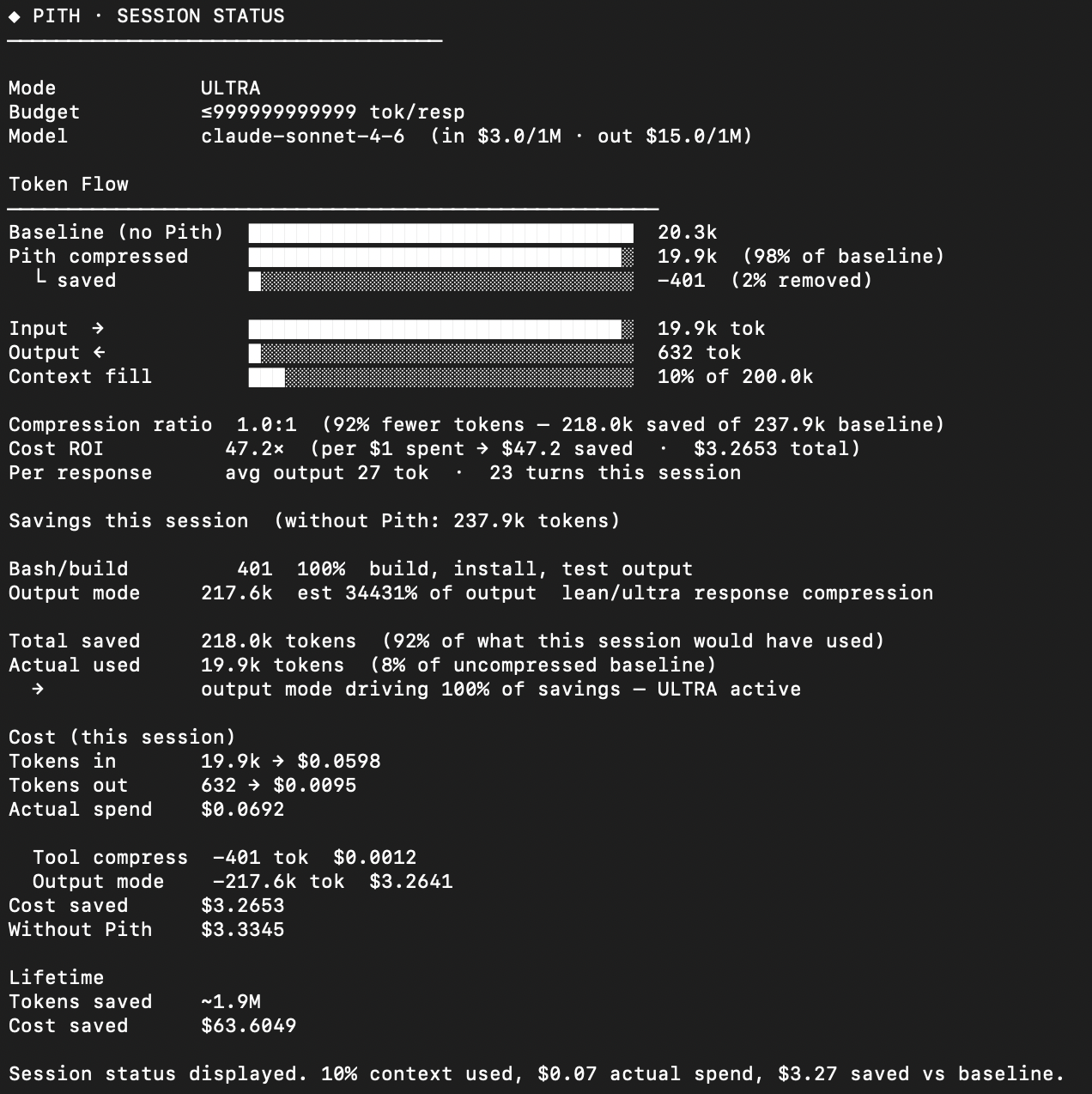
Pith is installed once, globally. It activates automatically in every Claude Code project — no per-project setup, no CLAUDE.md edits required.
01
Tool output compression
File reads return imports, signatures, and types — not every line. JSON outputs are serialised as TOON (~40% fewer tokens). Bash returns errors and a summary. Grep caps at 25 matches. Automatic, session-wide, always on.
02
Live context meter
Exact context window usage, mode, budget, and a full per-format savings breakdown — skeletons, bash/build, grep, TOON, web fetch, offload, output mode — each with a mini bar showing its share. Now includes an ASCII token flow diagram: baseline vs compressed vs output, showing exactly how much was intercepted and what arrived in context. Cost is split at the correct rate: tool compression at $3/1M, output mode savings at $15/1M. For a richer view, /pith report generates an interactive HTML dashboard.
03
Auto-compact at 70%
History is summarised automatically before the context window fills. Sessions run indefinitely. No more "context limit reached" mid-task.
04
Project wiki
Four page types — Decision, Concept, Entity, Synthesis — written and maintained as you work. Cross-linked, sourced, and queryable at any time.
05
Interactive knowledge graph
Force-directed D3.js graph of your entire wiki. Focus hover, pill labels, light/dark mode, zoom/pan, drag physics. Standalone HTML — zero dependencies.
06
YAML provenance
Every wiki page carries a frontmatter block linking claims back to raw source files, GitHub PRs, or session timestamps. Hallucinations become traceable.
07
Semantic lint
Detects contradictions between pages — not just broken links. Flags stale claims, orphan pages, missing source citations, and index mismatches.
08
Token budgets
Hard ceilings enforced by Pith — Claude won't exceed the limit without warning. Set with /budget 150, clear with /budget off.
09
Ingest pipeline
Feed any file to the wiki with /pith ingest. Pith extracts entities, concepts, and contradictions, shows a diff, and waits for your confirmation before writing anything.
10
Session persistence
Mode, wiki state, and budget are saved on session exit — per project. Next session offers one-line restore. /pith recall restores mid-session. /pith configure walks through all settings interactively.
11
In-Claude install
Install Pith without leaving Claude Code. /pith install locates the plugin, runs the installer, copies hooks, patches settings.json, registers slash commands, and verifies every step succeeded.
12
Clean uninstall
/pith uninstall removes hooks, slash commands, and all settings.json entries cleanly. Asks for confirmation first. Your project wikis and lifetime token history are preserved unless you explicitly request a full wipe.
13
Symbol extractor
Jump directly to any function, class, or method with /pith symbol <file> <name>. Returns the exact 30–50 lines of the definition — ~95% fewer tokens than reading the full file. Uses tree-sitter AST when available, regex fallback otherwise. Supports Python, TS/JS, Go, and more.
14
Tool result offloading
Tool outputs that exceed 300 tokens after compression are automatically written to ~/.pith/tmp/ and replaced with a 3-line pointer in context. Claude can read them on demand — nothing is lost, but large payloads never bloat the context window. Offloaded bytes tracked in /pith status.
17
jCodeMunch wiki ingest jCodeMunch · 2026
When you /pith ingest a code file, Pith runs symbols.py --list first to extract the structural skeleton — imports, signatures, class outlines — then passes that to a code-aware analysis prompt instead of raw source lines. Creates Module and Class wiki pages with exports, key methods, and architectural dependencies rather than generic concept pages.
16
Hindsight pruning Hindsight · 2026
Scans the session's tool call telemetry for stale context: files read multiple times (only the latest matters), large bash outputs from early-session setup steps, results that are now irrelevant. Reports total stale token cost and recommends /compact. Fires automatically once when context passes 60%.
15
Auto-escalation
As context fills, Pith automatically ratchets the output mode up — switching to LEAN at 50% and ULTRA at 70%. At 85%, a dynamic response ceiling is injected equal to 8% of remaining headroom. Claude's responses stop growing the context window unchecked. Toggle with /pith escalate on|off.
18
Cache-Lock Phase 9 · 2026
Session-start injection is hashed (MD5, 8 chars). If settings are identical to the previous session, a single compact summary line is emitted instead of the full rules block — saving ~300 tokens per session start. Dynamic values (token counts, timestamps) are deliberately excluded from the hash, ensuring cache hits are true stability signals, not coincidences.
19
Speculative Fetch + Session Report Phase 10 · 2026
When /pith symbol extracts a function, it automatically scans the body for calls to other functions defined in the same file and appends their signatures — eliminating a follow-up round-trip in ~60% of lookups. Pairs with /pith report, which generates a standalone HTML dashboard (Chart.js) showing token flow, per-bucket savings, cost breakdown, and a compression event timeline.
20
Multi-model pricing
Cost estimates auto-detect your model from the transcript — Opus 4.x, Sonnet 4.x, Haiku 4.x, and prior generations. Correct $/MTok rates applied per session automatically. No config needed. Falls back to Sonnet 4.6 rates if model ID is unavailable.
21
Self-updating
Already installed? /pith update pulls the latest version and re-syncs all hooks, slash commands, and settings in one step. No manual reinstall or curl-pipe needed for existing users.
22
Mtime caching — symbol & focus v1.3 · 2026
Every /pith symbol and /pith focus result is cached keyed by path:mtime:symbol in /tmp/pith-symbols-cache.json. Repeated lookups on the same file within a session return instantly — no re-read, no re-parse. Cache is invalidated the moment the file changes. Cap of 500 entries; oldest pruned automatically.
23
Source manifest + parallel compile v1.3 · 2026
/pith compile fingerprints every source file (mtime:size) and stores the manifest in wiki/.compile-manifest.json. On the next run, only changed sources are reprocessed — unchanged sources are skipped instantly. Page writes run in parallel via ThreadPoolExecutor(4), cutting wall-clock time 3–5×. An exclusive lock file prevents concurrent runs from racing. Prompt caching via cache_control: ephemeral amortizes the static instruction block across all N page-write API calls in a compile run.
24
Ingest deduplication v1.3 · 2026
Before running a Claude analysis, /pith ingest checks wiki/.ingest-manifest.json for a fingerprint of the source file. If the file hasn't changed since it was last ingested, the command exits immediately — no duplicate wiki pages, no wasted API call. Pass --force to override. The manifest is updated atomically after every successful ingest.
25
Atomic writes + lint fingerprint cache v1.3 · 2026
Every wiki file write — pages, index, log — now goes through a path.{pid}.tmp → rename() pattern, which is atomic on POSIX. A crash mid-write leaves a stale .tmp file instead of a corrupted wiki page. /pith lint fingerprints all wiki pages via SHA-256 of combined mtimes; if the wiki is unchanged since the last run, the LLM semantic analysis is skipped entirely and the cached result is returned instantly.